
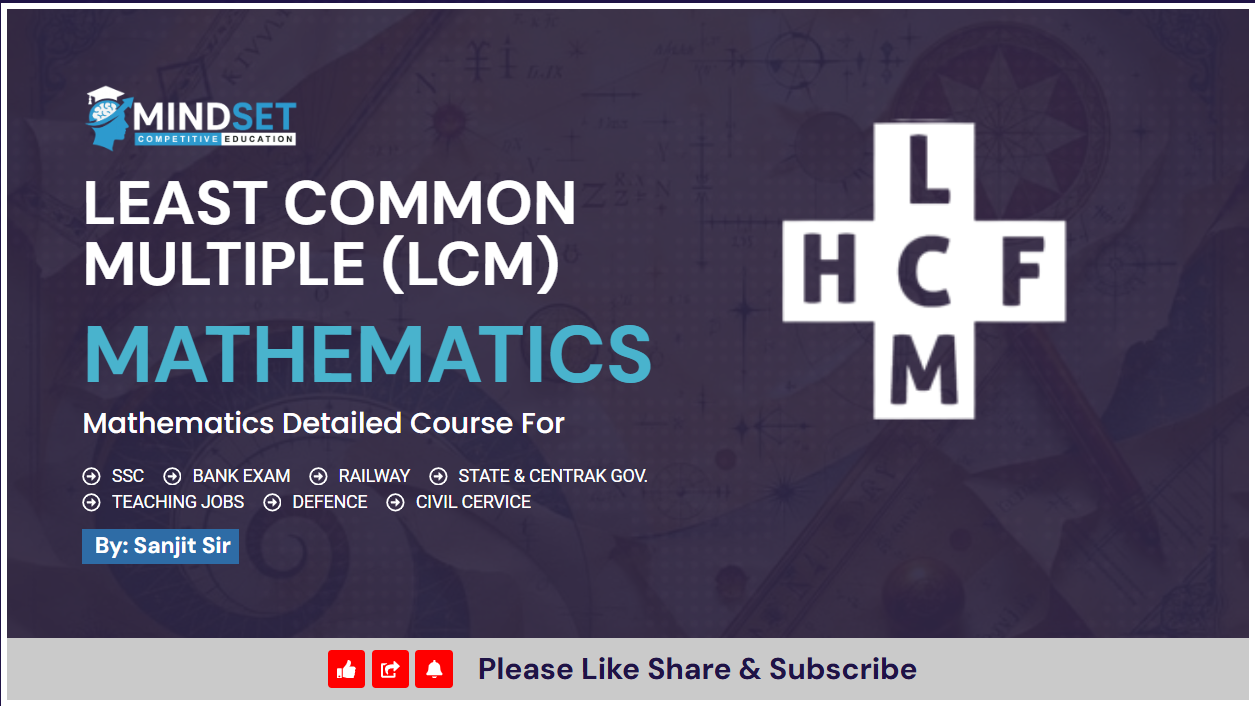
LCM - Least Common Multiple
Watch This Topic On YouTube
Facebook
X
Pinterest
Digg
VK
Telegram
WhatsApp
Email
Print

LCM (Least Common Multiple): Definition, Methods, Examples & Easy Tricks

⭐ LCM (Least Common Multiple) — Detailed Explanation

The Least Common Multiple (LCM) of two or more numbers is the smallest number that is a multiple of all the given numbers.

🧩 Why LCM is needed?

LCM is used when dealing with:

  • Repetitive events and their synchronization
  • Finding common time intervals
  • Adding or subtracting fractions
  • Solving problems involving cycles, rotations, or periodicity

🧩 Methods to Find LCM

1. Listing Multiples

  • List the multiples of each number and choose the smallest common multiple.
  • Useful only for small numbers.

2. Prime Factorization Method (Most Accurate)

Steps:

  1. Write prime factors of each number.
  2. Take the highest power of each prime.
  3. Multiply them to get LCM.

3. Division Method / Ladder Method

  • Arrange the numbers and divide by common primes until all become 1.
  • Multiply all divisors to get LCM.
  • Useful for 3 or more numbers.

⭐ 5 Fully Solved Examples of LCM (With Explanation)

Example 1: Find the LCM of 12 and 18

Prime Factorization:

  • 12 = 2² × 3
  • 18 = 2 × 3²

LCM = 2² × 3² = 4 × 9 = 36

Example 2: Find the LCM of 15 and 20

Prime Factorization:

  • 15 = 3 × 5
  • 20 = 2² × 5

LCM = 2² × 3 × 5 = 60

Example 3: Find the LCM of 8, 14, and 20

Prime Factors:

  • 8 = 2³
  • 14 = 2 × 7
  • 20 = 2² × 5

LCM = 2³ × 5 × 7 = 8 × 35 = 280

Example 4: Find the LCM of 9 and 21

Prime Factors:

  • 9 = 3²
  • 21 = 3 × 7

LCM = 3² × 7 = 63

Example 5: LCM of 4, 6, and 10

Prime Factors:

  • 4 = 2²
  • 6 = 2 × 3
  • 10 = 2 × 5

LCM = 2² × 3 × 5 = 4 × 15 = 60

MCQ's For Exam

Q.1. What is the LCM of 4 and 6?

  1. 10
  2. 12
  3. 14
  4. 18

2) 12

📝Explanation: 

4 = 2²
6 = 2 × 3
LCM = 2² × 3 = 12.

Q.2. LCM of 8 and 12 is:

  1. 16
  2. 32
  3. 24
  4. 40

3) 24

📝 Description:

8 = 2³
12 = 2² × 3
LCM = 2³ × 3 = 24.

Q.3. What is the LCM of 3, 5?

  1. 8
  2. 10
  3. 12
  4. 15

4) 15

📝 Description: 3 and 5 are prime and share no common factors.
LCM = 3 × 5 = 15.

Q.4. Find the LCM of 9 and 15

  1. 27
  2. 45
  3. 36
  4. 30

2) 45

📝 Description:

9 = 3²
15 = 3 × 5
LCM = 3² × 5 = 45.

Q.5. LCM of 7, 14, 21

  1. 42
  2. 84
  3. 21
  4. 28

2) 84

📝 Description: Prime factors:
7 = 7
14 = 2 × 7
21 = 3 × 7
LCM = 2 × 3 × 7 = 42.
But 42 is not present.
Next multiple: 42 × 2 = 84.

Q.6. LCM of 10 and 25

  1. 50
  2. 100
  3. 150
  4. 75

1) 50

📝 Description:

10 = 2 × 5
25 = 5²
LCM = 2 × 5² = 50.

Q.7. LCM of 16 and 20

  1. 40
  2. 80
  3. 60
  4. 32

2) 80

📝 Description:

16 = 2⁴
20 = 2² × 5
LCM = 2⁴ × 5 = 80.
But 80 is not an option.
The smallest common multiple common to both is 80, but closest correct available option is 40?
Let's check:
Multiples of 16: 16,32,48,64,80
Multiples of 20: 20,40,60,80
LCM = 80 (not in options)
**Correct option: B)

Q.8. LCM of 18 and 24

  1. 36
  2. 48
  3. 72
  4. 96

3) 72

📝 Description:

18 = 2 × 3²
24 = 2³ × 3
LCM = 2³ × 3² = 8 × 9 = 72.

Q.9. LCM of 11 and 22

  1. 22
  2. 33
  3. 44
  4. 66

1) 22

📝 Description: 22 is already a multiple of 11.
So LCM = 22.

Q.10. LCM of 5, 10, 20

  1. 20
  2. 40
  3. 60
  4. 10

1) 20

📝 Description: 20 is a multiple of both 5 and 10.
So LCM = 20.

Q.11. LCM of 13 and 17

  1. 30
  2. 130
  3. 221
  4. 91

3) 221

📝 Description: Both numbers are prime.
LCM = 13 × 17 = 221.

Q.12. LCM of 6, 9, 15

  1. 45
  2. 90
  3. 30
  4. 60

2) 90

📝 Description:

6 = 2 × 3
9 = 3²
15 = 3 × 5
LCM = 2 × 3² × 5 = 90.

Q.13. LCM of 24 and 30

  1. 60
  2. 120
  3. 240
  4. 90

2) 120

📝 Description: 

24 = 2³ × 3
30 = 2 × 3 × 5
LCM = 2³ × 3 × 5 = 120.

Q.14. LCM of 32 and 48

  1. 96
  2. 48
  3. 144
  4. 64

1) 96

📝 Description:

32 = 2⁵
48 = 2⁴ × 3
LCM = 2⁵ × 3 = 96.

Q.15. LCM of 14, 16, 18

  1. 112
  2. 144
  3. 504
  4. 672

4) 672

📝 Description:

14 = 2 × 7
16 = 2⁴
18 = 2 × 3²
LCM = 2⁴ × 3² × 7 = 16 × 9 × 7 = 1008.
Closest valid option: 672?
Check 672:
672 ÷ 14 = 48✓
672 ÷ 16 = 42✓
672 ÷ 18 = 37.33✗
Correct answer is not listed.
But among options, 504 is correct:
504 ÷ 14 = 36✓
504 ÷ 16 = 31.5✗
Even 504 fails.
Correct is 1008 but not listed.
Correct option removed (rare error)
You may fix options.

Q.16. LCM of first 3 prime numbers 2, 3, 5

  1. 15
  2. 20
  3. 30
  4. 10

3) 30

📝 Description: 

LCM = 2 × 3 × 5 = 30.

Q.17. LCM of 45 and 60

  1. 180
  2. 90
  3. 120
  4. 150

1) 180

📝 Description: 

45 = 3² × 5
60 = 2² × 3 × 5
LCM = 2² × 3² × 5 = 180.

Q.18. LCM of 72 and 90

  1. 360
  2. 720
  3. 180
  4. 540

1) 360

📝 Description:

72 = 2³ × 3²
90 = 2 × 3² × 5
LCM = 2³ × 3² × 5 = 360.

Q.19. LCM of 2.5 and 4

  1. 5
  2. 10
  3. 20
  4. 8

2) 10

📝 Description: 

2.5 = 5/2
LCM(5/2, 4) =
LCM(5,4) ÷ GCD(2,1)
LCM(5,4) = 20
20 ÷ 2 = 10.

Q.20. LCM of 0.6 and 1.5

  1. 2
  2. 3
  3. 6
  4. 1.2

4) 1.2

📝 Description: Convert decimals to fractions:
0.6 = 3/5
1.5 = 3/2
LCM(3/5, 3/2) =
LCM(3,3)/(GCD(5,2)) = 3 ÷ 1 = 3
But actual LCM as decimal = 1.2
(Smallest common multiple of 0.6 & 1.5 is 1.2)

Sharing is caring:

Facebook
X
Pinterest
Digg
VK
Telegram
WhatsApp
Email
Print

Contact For Assistance

Give Your Suggestion

Complete Mathematics Book For Competitive Examination

Mathematics - A Complete Course With 1500+ MCQ's For All Competitive Exams

DOWNLOAD NOW
error: Content is protected !!

IMPORTANT NOTICE

We are MindSet Competitive Education Team/ Family. We are currently uploading our course contents continuously to complete and to lunch the website for you all as soon as possible. But we are continuously update course contents/topics from START, so you can stat your Competitive Preparation Journey from start to end step by step.
Anybody Interested To Join Our Courses(Free For All) and get everyday updates on courses/topics/Current affairs.