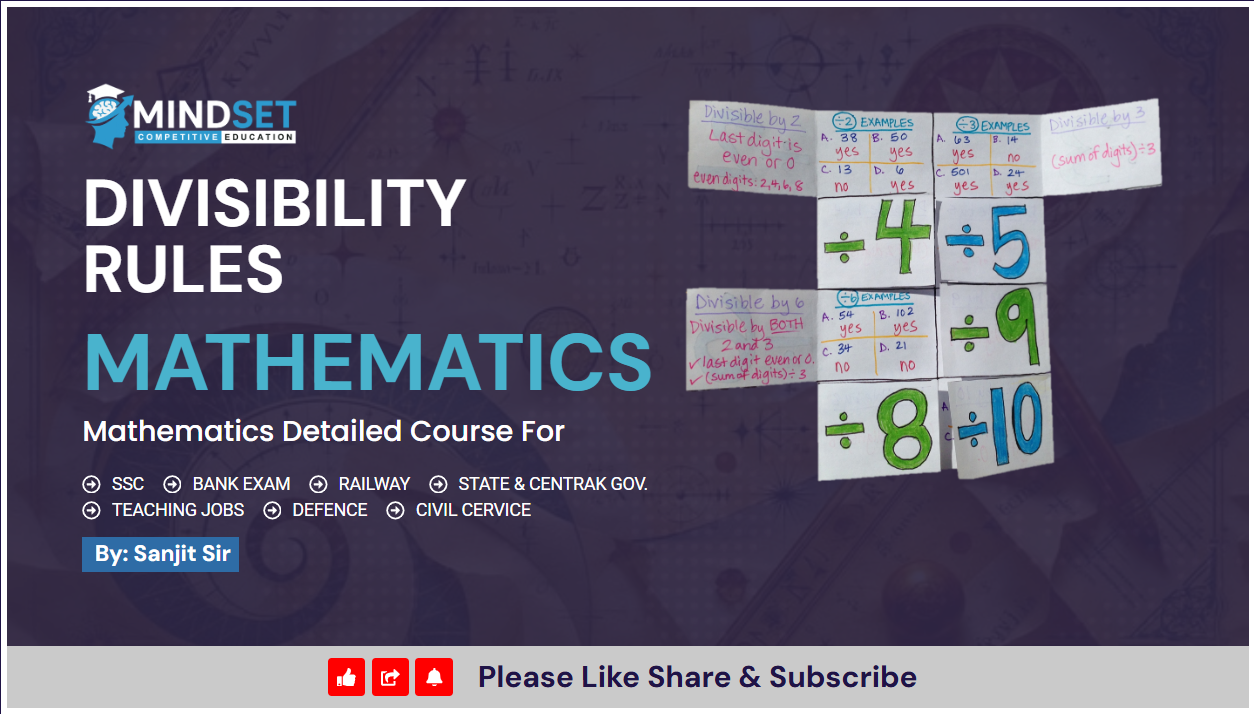
Divisibility rules help you quickly determine whether a number is divisible by another without performing full division. These rules are extremely useful in competitive exams for speed and accuracy.
A number is divisible by 2 if its last digit is even (0, 2, 4, 6, 8).
Example:
246 → last digit 6 → divisible by 2.
A number is divisible by 3 if the sum of its digits is divisible by 3.
Example:
372 → 3+7+2=12 (divisible by 3) → divisible by 3.
A number is divisible by 4 if the last two digits form a number divisible by 4.
Example:
516 → last two digits 16 → divisible by 4 → yes.
A number is divisible by 5 if its last digit is 0 or 5.
Example:
475 → ends with 5 → yes.
A number is divisible by 6 if it is divisible by both 2 and 3.
Example:
234 → even & sum=2+3+4=9 divisible by 3 → yes.
A number is divisible by 7 using:
Example: 203 → 20 – (2×3)=20–6=14 → divisible.
Example:
266 → 26 – (2×6)=26−12=14 → divisible → yes.
A number is divisible by 8 if the last 3 digits form a number divisible by 8.
Example:
1032 → last three digits 032 = 32; 32 not divisible by 8 → no.
A number is divisible by 9 if sum of digits is divisible by 9.
Example:
693 → 6+9+3=18 (divisible by 9) → yes.
A number is divisible by 10 if its last digit is 0.
Example:
980 → ends with 0 → yes.
A number is divisible by 11 if:
Example: 121 → (1 + 1) – 2 = 0 → divisible.
Example:
583 → (5+3) – 8 = 0 → divisible by 11.
📝Explanation: A number is divisible by 2 if its last digit is even (0,2,4,6,8). Option 328 ends with 8, so it is even and divisible by 2. The other choices end with odd digits (5,7,9), so they fail the divisibility-by-2 test and are not divisible by 2.
📝 Description: A number is divisible by 3 if the sum of its digits is divisible by 3. For 357, 3 + 5 + 7 = 15, and 15 ÷ 3 = 5 (no remainder), so 357 is divisible by 3. The other options have digit sums 7, 7, and 1 respectively, none divisible by 3.
📝 Description: A number is divisible by 4 when its last two digits form a number divisible by 4. For 812, the last two digits are 12, and 12 ÷ 4 = 3 (exact). Thus 812 is divisible by 4. The other options end with 23, 07, and 31, which are not divisible by 4.
📝 Description: A number is divisible by 5 only if it ends with 0 or 5. Among the options, 340 ends with 0, making it divisible by 5. All other numbers end with different digits (7, 2, 9), so they do not satisfy the divisibility rule for 5.
📝 Description: A number divisible by 6 must also be divisible by 2 (even number) and 3 (digit sum divisible by 3). 114 is even and its digit sum = 1+1+4 = 6, which is divisible by 3. Hence it satisfies both rules. Others fail the divisibility test for 2 or 3.
📝 Description: Using the divisibility rule for 7, subtract twice the last digit from the remaining number.
84 → 8 – (2×4)=8−8=0 → divisible
140 → 14 – (2×0)=14 → divisible
Thus both 84 and 140 are divisible by 7, while 95 is not.
📝 Description: A number is divisible by 8 if its last three digits form a number divisible by 8.
216 → divisible by 8
012 → 12 divisible by 8
744 → divisible by 8
Since all options satisfy the rule, the correct answer is All of these.
📝 Description: The divisibility rule for 9 states that if the sum of digits of a number is divisible by 9, the entire number is divisible by 9. Although numbers divisible by 9 are also divisible by 3, option C is the correct and most specific rule being asked.
📝 Description: A number divisible by 10 must end with 0. Among the options, only 450 ends with 0. The remaining options end in 3, 9, and 5 respectively, which do not satisfy the rule for divisibility by 10.
📝 Description: A number is divisible by 11 if the difference between the sum of digits in odd and even positions is 0 or divisible by 11.
121 → (1+1)−2=0
242 → (2+2)−4=0
Both satisfy the rule, while 374 does not. Hence option D.
📝 Description: To find the combined divisibility, we use the LCM of 4 and 6.
LCM(4, 6) = 12.
Therefore, any number divisible by both 4 and 6 must necessarily be divisible by 12, making option C correct.
📝 Description: A number divisible by 3 has digit sum divisible by 3; divisible by 9 requires digit sum divisible by 9.
444 → 4+4+4=12 → divisible by 3 but not by 9.
Other options have sums 9, 15, and 18 (all divisible by 9).
📝 Description: For divisibility by 8, check last three digits. 128 ÷ 8 = 16, so any number ending with 128 is divisible by 8.
It is also divisible by 4, but NOT always by 16. Hence the most accurate and safest answer is 8.
📝 Description: A number is divisible by 11 if the alternating sum of its digits (odd position sum minus even position sum) is 0 or divisible by 11. No other number uses this rule, making 11 the unique correct answer.
📝 Description: Check last digits:
For 8 → last 3 digits 608 → divisible
For 16 → last 4 digits 4608 → divisible
For 32 → 4608 ÷ 32 = 144
Since the number satisfies all three divisibility rules, the answer is All.
📝 Description: Apply digit-sum rule:
8991 → 8+9+9+1 = 27 → divisible
9117 → 9+1+1+7 = 18 → divisible
4356 → 4+3+5+6 = 18 → divisible
Since all have digit sums divisible by 9, all are divisible.
📝 Description: Using the divisibility test or known multiples:
231 = 7 × 33
350 = 7 × 50
448 = 7 × 64
Since all numbers are exact multiples of 7, option D is correct.
📝 Description: Digit-sum 27 is divisible by both 3 and 9. Therefore, any number with a digit sum of 27 is divisible by both 3 and 9. It cannot be divisible by only one of them, so option C is correct.
📝 Description: 1001 is a special number because:
1001 = 7 × 11 × 13
Thus, it is divisible by all three numbers mentioned in the options. Therefore, the correct answer is All.
📝 Description: A number divisible by 6 must be divisible by both 2 and 3.
222 → even AND its digit sum = 2+2+2=6 (divisible by 3).
Other options either have digit sums not divisible by 3 or fail one of the rules.
Copyright © 2004-2025 Mind Set Education – Managed By: mLand India Technologies. All Rights Reserved.

We are MindSet Competitive Education Team/ Family. We are currently uploading our course contents continuously to complete and to lunch the website for you all as soon as possible. But we are continuously update course contents/topics from START, so you can stat your Competitive Preparation Journey from start to end step by step.