Real Numbers (R) – Definition, Properties, Examples & 20 Solved MCQs for Competitive Exams
Watch This Topic On YouTube
Facebook
X
Pinterest
Digg
VK
Telegram
WhatsApp
Email
Print

Real Numbers (R) – Definition, Properties, Examples & 20 Solved MCQs for Competitive Exams

⭐ Real Numbers (R) – Detailed Description

Real Numbers, denoted by R, include all numbers that can be represented on the number line.
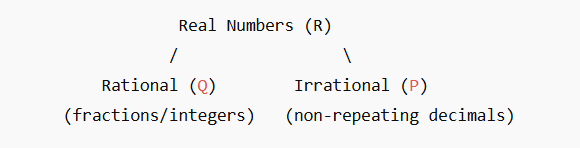
Real numbers combine rational numbers and irrational numbers.​

Real Numbers Include:

  1. Natural Numbers (N) → {1, 2, 3, …}
  2. Whole Numbers (W) → {0, 1, 2, 3, …}
  3. Integers (Z) → {…, –3, –2, –1, 0, 1, 2, 3, …}
  4. Rational Numbers (Q) → p/q (q ≠ 0)
  5. Irrational Numbers (P) → √2, π, e, etc.

Key Features of Irrational Numbers

  1. Real numbers cover all rational and irrational numbers
  2. Every real number has a unique position on the number line
  3. Can be positive, negative, or zero
  4. Include terminating, repeating, and non-repeating decimals
  5. Real numbers are closed under addition, subtraction, multiplication, and division (except division by 0)
  6. Between any two real numbers, infinitely many real numbers exist

Real Numbers Classification Diagram

real numbers for competitive examination

5 Examples of Real Numbers (with Explanation)

  • 7: A natural, whole, and integer → Real number.
  • –12: A negative integer → Real number.
  • 4.25: Terminating decimal → Rational → Real number.
  • 0.333… (repeating): Repeating decimal → Rational → Real number.
  • √3: Non-terminating, non-repeating decimal → Irrational → Real number.

MCQ's For Exam

Q.1. Which of the following is a real number?

  1. √2
  2. –3
  3. 5/7
  4. All of these

4) All of these

📝Explanation: All rational & irrational numbers are real.

Q.2. Real numbers include:

  1. Only integers
  2. Only rational numbers
  3. Rational + Irrational numbers
  4. Only natural numbers

3) Rational + Irrational numbers

📝 Description: R = Q + P.

Q.3. Which is NOT a real number?

  1. 5
  2. π
  3. 0
  4. √(–4)

4) √(–4)

📝 Description: √(–4) = 2i → imaginary, not real.

Q.4. Which of the following is an irrational real number?

  1. 3/4
  2. 0.25
  3. √5
  4. –2

3) √5

📝 Description: Non-perfect square root → irrational → real.

Q.5. Which decimal represents a real number?

  1. 0.66
  2. 0.333…
  3. 2.718281…
  4. All

4) All

📝 Description: All decimals (whether terminating, repeating, or non-repeating) belong to real numbers.

Q.6. Real numbers can be represented on:

  1. Number line
  2. Prime line
  3. Complex plane only
  4. None

1) Number line

📝 Description: All real numbers lie on the real number line.

Q.7. Sum of two real numbers is always:

  1. Real
  2. Imaginary
  3. Undefined
  4. Fraction

1) Real

📝 Description: Real numbers are closed under addition.

Q.8. Which number is rational, hence real?

  1. √7
  2. π
  3. –5/8
  4. e

3) –5/8

📝 Description: Fraction of integers → rational → real.

Q.9. Which set is a subset of real numbers?

  1. Natural Numbers
  2. Whole Numbers
  3. Integers
  4. All

4) All

📝 Description: N, W, Z ⊂ Q ⊂ R.

Q.10. Real numbers extend:

  1. Only to positive
  2. Only to negative
  3. In both positive and negative direction
  4. Only whole numbers

3) In both positive and negative direction

📝 Description: They include negative & positive & zero.

Q.11. Which is an irrational real number?

  1. 0.1010010001…
  2. 0.75
  3. 3
  4. –1

1) 0.1010010001…

📝 Description: Non-terminating, non-repeating decimal → irrational.

Q.12. Which of the following represents a rational real number?

  1. √2
  2. π
  3. 5.121212…
  4. √11

3) 5.121212…

📝 Description: Repeating decimal → rational → real.

Q.13. Between 1 and 2, how many real numbers exist?

  1. 1
  2. 10
  3. 100
  4. Infinite

4) Infinite

📝 Description: Real numbers are dense → infinite between any two.

Q.14. √49 belongs to:

  1. Rational numbers only
  2. Irrational numbers
  3. Real numbers
  4. Both a and c

4) Both a and c

📝 Description: √49 = 7 → rational → also real.

Q.15. Which number is NOT real?

  1. –2
  2. 0
  3. √25
  4. √–9

4) √–9

📝 Description: √–9 = 3i → imaginary.

Q.16. Which pair consists of real numbers?

  1. √3, π
  2. 3i, 5i
  3. 1+i, 2+i
  4. –i, i

1) √3, π

📝 Description: √3 and π are irrational → both real.

Q.17. Which is TRUE?

  1. The product of two irrational numbers is always irrational
  2. The sum of two irrational numbers is always irrational
  3. Rational + irrational = irrational
  4. All real numbers are integers

3) Rational + irrational = irrational

📝 Description: Rational + irrational always gives irrational.

Q.18. Simplify: √12 – √3

  1. √9
  2. 3√3
  3. 2√3 – √3 = √3
  4. 2√3

3) 2√3 – √3 = √3

📝 Description: √12 = 2√3
2√3 – √3 = 1√3 = √3

Q.19. Which of these is a real number but NOT rational?

  1. –5
  2. 1.23
  3. √7
  4. 4

3) √7

📝 Description: √7 is irrational but real.

Q.20. If a and b are real numbers, then (a – b) is:

  1. Always real
  2. Always imaginary
  3. Always integer
  4. Undefined

1) Always real

📝 Description: Real numbers are closed under subtraction.

Sharing is caring:

Facebook
X
Pinterest
Digg
VK
Telegram
WhatsApp
Email
Print

Contact For Assistance

Give Your Suggestion

Complete Mathematics Book For Competitive Examination

Mathematics - A Complete Course With 1500+ MCQ's For All Competitive Exams

DOWNLOAD NOW
error: Content is protected !!

IMPORTANT NOTICE

We are MindSet Competitive Education Team/ Family. We are currently uploading our course contents continuously to complete and to lunch the website for you all as soon as possible. But we are continuously update course contents/topics from START, so you can stat your Competitive Preparation Journey from start to end step by step.
Anybody Interested To Join Our Courses(Free For All) and get everyday updates on courses/topics/Current affairs.